
[CONCEPT R&D] GOWINI v3.1 | Executive Summary
Universal MEMS Micro-Fluidic Cooling Platform | Rev. A (Theoretical Concept Stage)
Disclaimer: This is an independent theoretical R&D proposal and architectural concept. It is currently at the simulation and preliminary feasibility stage.
Problem and Approach
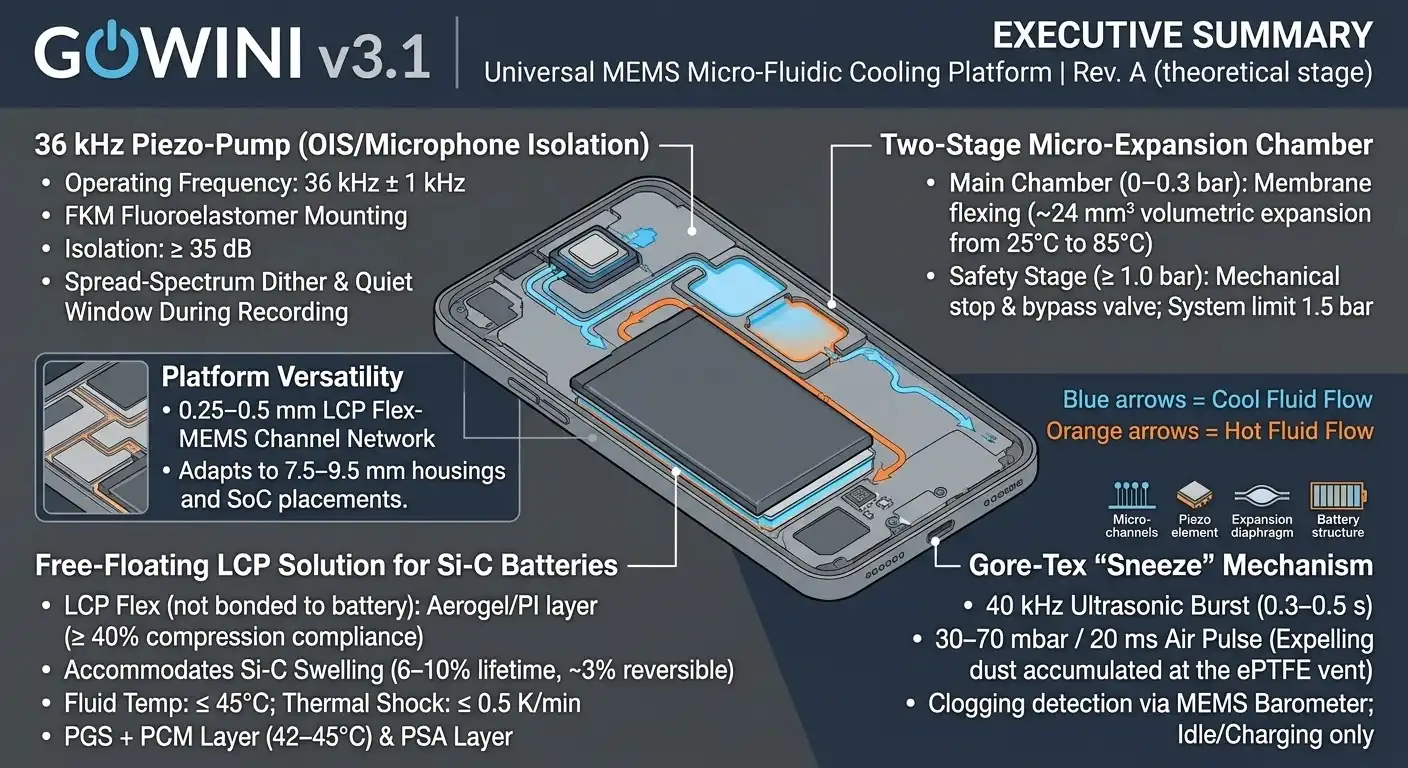
In steady state, a passive smartphone body dissipates roughly 3.5–4 W of heat, which sets the touch-temperature limit (~48°C). Gowini does not raise this ceiling. Its purpose is to reduce the SoC hotspot gradient, extend boost duration, and spread heat evenly across the entire chassis. The platform is built on a 0.25–0.5 mm LCP flex-MEMS channel network and adapts to 7.5–9.5 mm housings and different SoC placements.
4 Key Technical Innovations
1. 36 kHz piezo-pump frequency (OIS/microphone isolation)
The initial 20 kHz choice overlaps with the MEMS gyroscope drive-mode band (20–30 kHz) and the audio filter edge. The operating frequency is shifted to 36 kHz ± 1 kHz.
FKM fluoroelastomer mounting (f_n \approx 500\text{ Hz}) provides \ge 35\text{ dB} isolation by conservative estimate.
Spread-spectrum dither and a burst-synchronized quiet window during camera/audio recording.
2. Two-stage Micro-Expansion Chamber
Stage 1 (0–0.3 bar): the membrane flexes freely, absorbing the ~3% volumetric expansion (\sim 24\text{ mm}^3) between 25°C → 85°C.
Stage 2 (\ge 1.0\text{ bar}): a mechanical stop and bypass valve protect the 1.5 bar limit.
Channel compliance damps hydraulic shock (water hammer). Experimental validation required.
3. Gore-Tex "Sneeze" mechanism
A 40 kHz ultrasonic burst (0.3–0.5 s) breaks particle-membrane bonds.
A 30–70 mbar / 20 ms air pulse from the expansion chamber membrane expels moist and oily dust accumulated at the vent. Both stages use the same membrane.
Operates only in idle/charging mode; clogging is detected by a MEMS barometer. Energy for 10 cycles per day is \approx 0.08\text{ mWh} (negligible).
4. Free-Floating LCP solution for Si-C batteries
The cooling flex is not bonded to the battery. An aerogel/PI layer with \ge 40\% compression compliance accommodates Si-C swelling (6–10% over lifetime, ~3% reversible).
Fluid temperature above the battery \le 45^\circ\text{C}, with heat flux limited: the \le 0.5\text{ K/min} thermal-shock criterion is met (calculated \approx 0.26\text{ K/min}).
A PGS + PCM (42–45°C) layer smooths boost peaks; CTE mismatch with aluminum and titanium housings is absorbed by a PSA layer.
Key Specifications ParameterValue
Working fluid35% propylene glycol / DI water + inhibitor
Channel materialLCP 50 µm + Parylene-C / ALD \text{Al}_2\text{O}_3 barrier layer
Stack-up variantsS: 0.25 mm / M: 0.35 mm / L: 0.50 mm
Nominal flow rate10 mL/min (boost mode only)
Channel pressure drop (M)\approx 5.7\text{ kPa} (\approx 12\text{ kPa} system-wide)
Piezo frequency36 kHz ± 1 kHz
Pump electrical power\approx 100\text{--}250\text{ mW} (boost)
Total fluid volume\approx 0.8\text{ mL}
Normal gauge pressure / limit\le 0.3\text{ bar} / 1.5 bar
Gore ventØ6 mm ePTFE, IP68
Cleaning method40 kHz burst + pneumatic pulse
Thermal layersPGS 25 µm + PCM 0.25 mm (~100 J) + aerogel/PI 0.3 mm
Hot-zone convective resistance\ Risks and Next Steps
Priority FMEA risks: Si-C swelling (RPN 160), ultrasonic interference (RPN 140), drop impact/flex fatigue (RPN 128).
Next phase: COMSOL/Ansys conjugate heat-transfer simulation and acoustic-structural analysis, followed by prototype tests (1.5 bar leak-tightness, 1,000 thermal shock cycles, IP68, gyro bias and microphone spectrum).
IP Status: The four core innovations are candidates for patent claim drafting. Novelty status must be confirmed through prior-art search.
Note: The Gowini v3.1 architecture is an ongoing theoretical concept. Internal calculations and material tolerances remain subject to verification in subsequent simulation rounds. Tags / Mentions:
@Xiaomi Community @Xiaomi R&D Concept
#Xiaomi #CoolingTechnology #MEMS #SmartphoneInnovation
[KONCEPCIÓ K+F] GOWINI v3.1 | Végrehajtási Összefoglaló Univerzális MEMS Mikro-Folyadék Hűtés Pla…
[CONCEPT R&D] GOWINI v3.1 | Executive Summary Universal MEMS Micro-Fluidic Cooling Pla…
 Gowini RD1 óra ezelőtt · 👁 2 · ♥ 0 · 💬 0
🌐 A poszt eredeti nyelven jelenik meg.
Megnyitás a Xiaomi Communityn ↗ Forrás: Xiaomi Community. A tartalom a szerzőé.

Hozzászólások (0)
Még nincs hozzászólás.
Hozzászólni a Xiaomi Communityn, Mi-fiókkal tudsz.